
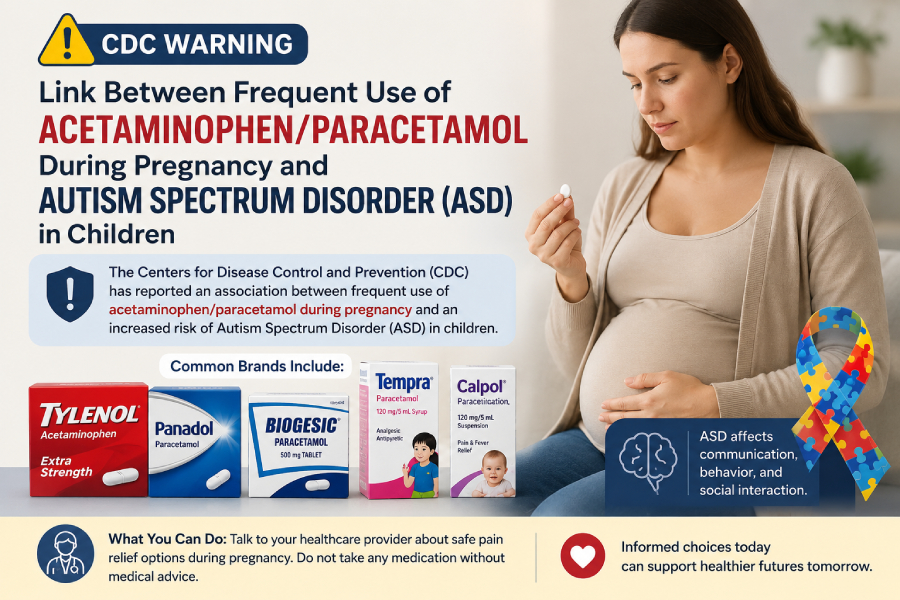
The Centers for Disease Control and Prevention (CDC) has raised concerns about the possible link between frequent use of Acetaminophen/Paracetamol (brand names: Tylenol, Panadol, Biogesic, Tempra, Calpol) during pregnancy and Autism Spectrum Disorder (ASD) in their children.
For clarity, Acetaminophen is the same drug as Paracetamol. The term Acetaminophen is used in North America and Japan, while Paracetamol is used in Europe, Australia, and most of Asia and Africa.
This brings so many questions, like:
- How does the frequent use of Acetaminophen/Paracetamol contribute to Autism risk?
- After birth, can babies, toddlers, or even adults be affected by the overuse of this anti-fever medication?
- If there is a link, why are only some babies affected and others are not? Is there a way to test who may be more vulnerable?
- Are there better ways of managing fevers?
This article explores all these questions and provides an overview of what you need to know about Acetaminophen/Paracetamol.
1. How does the frequent use of Acetaminophen/Paracetamol contribute to Autism risk?
The Centers for Disease Control and Prevention (CDC) has stated:
“Some studies of acetaminophen during pregnancy have shown an association with neurological conditions such as autism and ADHD, particularly when taken chronically throughout pregnancy. Although a direct causal relationship between acetaminophen and autism or ADHD has not been established, pregnant women should consider avoiding acetaminophen use during pregnancy as a precaution.”
(Source: Medicine and Pregnancy)
A recent study suggests the reason for Autism symptoms is due to how the drug breaks down into a toxic metabolite (NAPQI or N-acetyl-p-benzoquinone imine). This causes: “rusting” of cells (or oxidative stress); depletion of the body’s master antioxidant; damage to power units of cells (mitochondrial dysfunction); and inflammation of the brain (Chu, et al. 2025).
2. After birth, can babies, toddlers, or even adults be affected by the overuse of this anti-fever medication?
While the CDC has only implicated the link between Acetaminophen/Paracetamol during pregnancy and Autism for the children in the womb, there have been studies suggesting the association between Acetaminophen/Paracetamol use by babies and young children and Autism Spectrum Disorder.
In 2008 and 2016 Acetaminophen-Autism studies, it was observed that younger children (ages 12–18 months) are more likely to be given anti-fever medications after vaccinations. Thus, the Acetaminophen-Autism correlation was higher in that age group. The correlation was not as evident in older children. This was attributed to less use of anti-fever medication.
The researchers suggest that the toxic metabolites of Acetaminophen/Paracetamol dysregulate children’s endocannabinoid system, leading to brain inflammation (Schultz & Gould, 2016). The endocannabinoid system is a built-in communication system in your body that helps keep things in balance. This includes mood, stress response, memory/learning, focus/attention, and pain perception
Babies and children are not the only ones susceptible to the side effects of Acetaminophen overuse. In adults, frequent use of Acetaminophen toxicity is the leading cause of acute liver failure in the United States (Schaffer, Murray, & Khazaeni, 2026).
3. If there is a link, why are only some babies affected and others are not? Is there a way to test who may be more vulnerable?
Many possible theories have been presented to explain why some children are affected by Acetaminophen/Paracetamol and others are not. Scientists suggest this variability is likely due to a combination of factors, including maternal health conditions, timing and frequency of exposure, genetic differences, environmental influences, and overall pregnancy context.
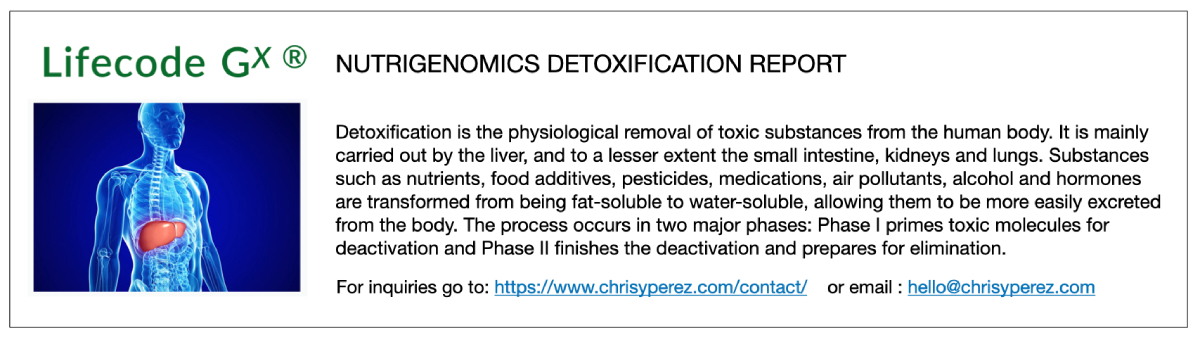
Each person processes medications differently. The growing field of Nutrigenomics can help assess an individual’s ability to detoxify Acetaminophen/Paracetamol. Nutrigenomic tests identify a person’s genetic variations that affect health, but more importantly, it provides nutritional solutions to influence better health.
Nutrigenomics provided by Lifecode Gx, the UK’s leading Nutrigenomics laboratory, has mapped genetic variations that affect the body’s ability to break down Acetaminophen/ Paracetamol.
Many people can effectively break down Acetaminophen/Paracetamol and safely discharge metabolites through urine. However, some individuals have genetic variations, which tend to break down Acetaminophen/Paracetamol towards the more toxic pathways that affect the nervous system. This can be identified in a Lifecode Gx Nutrigenomics Detoxification Test. The test further identifies if the individual has the genes that help further break down the toxic metabolites so they can be safely excreted.
More importantly, if an individual has unfavorable genetic variations, the nutrigenomics detoxification test report identifies nutritional support that helps detoxify and safely eliminate toxic Acetaminophen/Paracetamol metabolites.
4. Are there better ways of managing fevers?
Prevention is always better than a cure. It is first important to recognize that a fever is the body’s response and means of fighting an infection. When the brain detects an infection, it signals the body to increase temperature. High temperatures kill or deactivate viruses and bacteria. It also intensifies signals to activate the body’s immune defenses (Haddad & Winchester, 2026). See illustration for details.
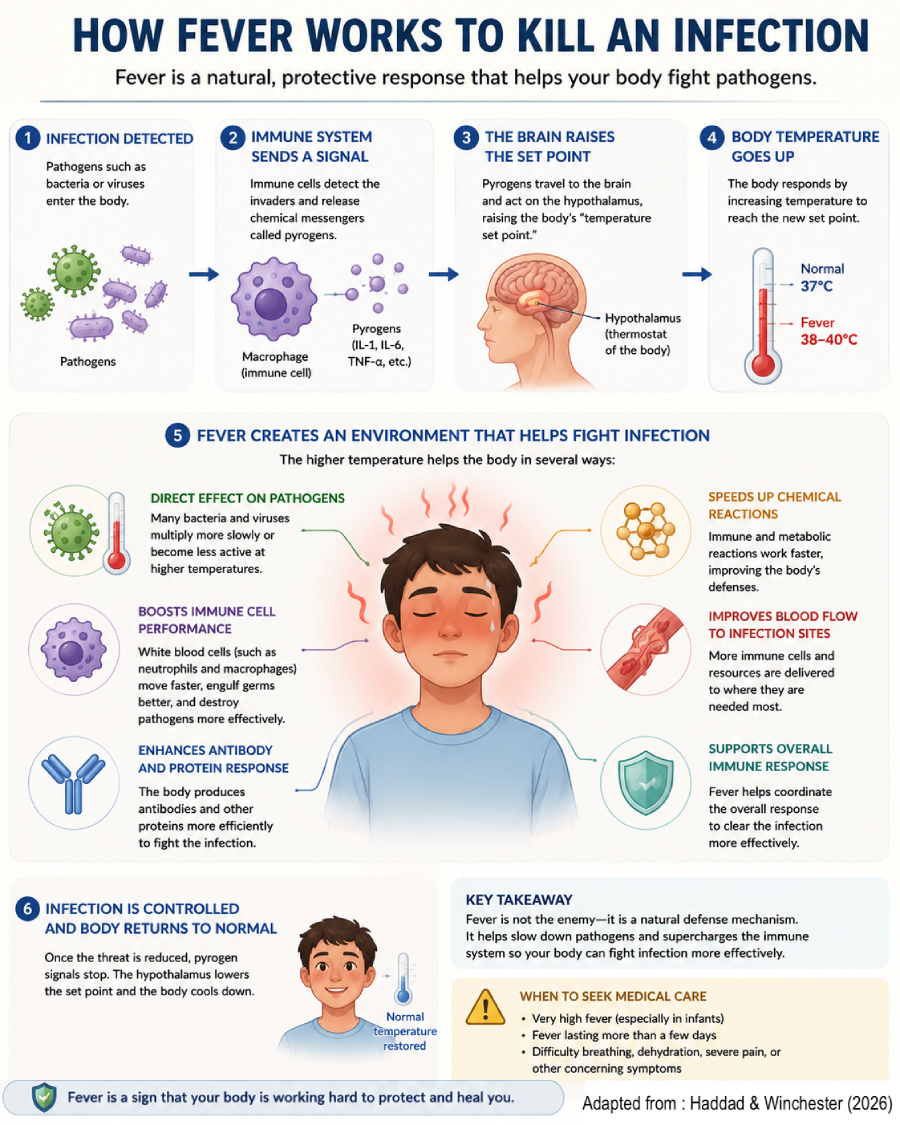
Ironically, reducing body temperature with anti-fever medications may cause more harm than good. Pharmaceuticals are aware of this. When reading the fine print, notice that anti-fever medications highlight that the benefit of using their product is to “relieve discomfort,” not to “fight the infection”.
To add insult to the injury, Acetaminophen/Paracetamol medication will deplete the body’s master antioxidant (glutathione), which is important for supporting the immune system when fighting an infection. This also compounds the risk of liver damage and failure due to overdose.
What are the alternatives?
Many natural remedies can help fight viral, bacterial, and fungal infections.
A supplement of interest is N-acetylcysteine (NAC). NAC inhibits viral and bacterial reproduction, so it fights the root cause or the fever, which is an infection. In complete contrast to fever-reducing medications, NAC supports the production of the master antioxidant (glutathione), thus protecting the liver. In fact, NAC is given as an antidote for liver damage due to Acetaminophen/Paracetamol overdose. Hospitals administer NAC intravenously for Acetaminophen-induced liver toxicity. NAC is also available as a supplement, which can be purchased from health food stores.
Many more natural, safe, and effective fever remedies, such as herbs, can easily be found and prepared at home. I have written about it in my book, “If Grandma Was a Doctor: The Science Behind Traditional Medicine.” Click here to learn more.
To compare natural remedies to anti-fever medications, the latter quickly brings down body temperature to provide comfort without addressing the root cause or the infection. In fact, not increasing body temperature allows viruses to survive and replicate in stealth mode. This may contribute to prolonged flu-associated symptoms even after the fever has gone.
Different natural remedies, on the other hand, can kill and inhibit the reproduction of viruses, bacteria, or fungi. When body temperature returns to normal due to herbal remedies, it indicates that the body has successfully overcome the infection.
Note: As per standard medical advice, bring your child to the doctor if the fever lasts more than 3 days, is accompanied by dehydration, pain, difficulty breathing, or other worrying symptoms.
Knowledge of natural remedies equips parents with tools they can use at the onset of a fever. It can help children safely fight off an infection and potentially avoid emergency hospital visits after 3 days.
References
- Alvarenga, L. M., Moraes, M. A., Flausino, A. R., Altoé-Adorno, B. S., Miranda, C. E. S., & Pitondo-Silva, A. (2026). Antimicrobial effects of N-acetylcysteine against bacterial strains associated with odontogenic infections. Brazilian journal of biology = Revista brasleira de biologia, 86, e303157.
- American Academy of Pediatrics. (2022, December 2). Fever: When to call the pediatrician. HealthyChildren.org.
- Centers for Disease Control and Prevention. (2025, September 22). Medicine and pregnancy: An overview.
- Chu, S., Woodfin, S., Bayliss, E., Smith, M., Fulp, A., Mirabelli, E., & Moore, W. (2025). Acetaminophen’s Role in Autism and ADHD: A Mitochondrial Perspective. International journal of molecular sciences, 26(17), 8585.
- Geiler, J., Michaelis, M., Naczk, P., Leutz, A., Langer, K., Doerr, H. W., & Cinatl, J., Jr (2010). N-acetyl-L-cysteine (NAC) inhibits virus replication and expression of pro-inflammatory molecules in A549 cells infected with highly pathogenic H5N1 influenza A virus. Biochemical pharmacology, 79(3), 413–420.
- Haddad, L. M., & Winchester, J. F. (2026). Fever. In StatPearls. StatPearls Publishing.
- Perez, C. (2024). If Grandma Was a Doctor: The science behind traditional remedies. Independently published.
- Schaffer, D. H., Murray, B. P., & Khazaeni, B. (2026). Acetaminophen toxicity. In StatPearls. StatPearls Publishing.
- Schultz, S. T., & Gould, G. G. (2016). Acetaminophen Use for Fever in Children Associated with Autism Spectrum Disorder. Autism-open access, 6(2), 170.
